


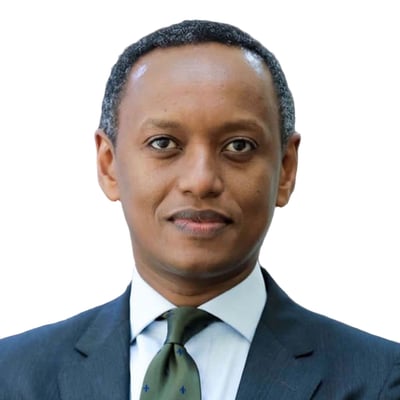
Blaise Pascal Gasabira
Chief Executive Officer
Rswitch Ltd
Blaise Pascal Gasabira is the CEO of RSwitch, Rwanda’s national payment switch, leading its transformation into a digital public infrastructure that ensures seamless interoperability across financial institutions. With a background in banking and digital finance, he drives innovation in payments, expanding access to secure, efficient, and inclusive digital transactions.
Speaking At
-
9:30–10:30amMon 16 NovWorkshopWorkshop Room 1Open
Global Frameworks and Shared Best Practices in Payments Chains
Sovereign Payments: Who Builds, Funds and Controls the Next Generation of Inclusive Instant Payment Systems? - Powered by Mojaloop
-
 Blaise Pascal GasabiraChief Executive OfficerRswitch Ltd
-
 H.E. Innocent B. MuhiziHigh Commissioner of Rwanda to SingaporeRepublic of Rwanda
-
 Jean Bosco IyacuChief Executive OfficerMojaloop Foundation
-
 Julie GuettaManaging DirectorThitsaWorks
-
 May LohCo-Lead, East Asia & Pacific PracticeDGA - Albright Stonebridge Group
-
 Steve HaleyGlobal Director, Mojaloop EcosystemMojaloop Foundation
-
 Walid AhmedDigital Payments Ecosystem AdvisorMojaloop FoundationModerator
About this session
Your payment rails are national infrastructure, so who really controls them? Instant payment systems are now national utilities, yet the key decisions often sit with a single vendor, an outside funder or experts who leave when the contract ends.
Sovereignty has three pillars, and you need all of them. Technical sovereignty means control over the technology and the freedom to change vendors. Skills sovereignty means local people and firms who can run and grow the system. Economic sovereignty means funding that keeps decision-making in national hands.
Sovereignty doesn’t mean going it alone. Open-source tools like Mojaloop, along with shared standards and peer learning, can give countries real ownership while sharing the costs of development and maintenance.
Straight talk from people who have done it. A country leader, a central bank operator, an implementer and a funder discuss where sovereignty is won or lost, from the first procurement decision to long-term operation.
The session will also present draft funding principles that support national ownership instead of eroding it, and invite funders and adopters to help shape them.
-
-
1:00–3:00pmMon 16 NovDesign ThinkingDesign Thinking RoomOpen
Global Frameworks and Shared Best Practices in Payments Chains
Scaling Real-Time Payments: Adoption, Commercial Innovation and the Economics of Inclusion - Powered by Gates Foundation
-
 Afgan AbbasovDirector, Payment Systems & Products DevelopmentCentral Bank of the Republic of Azerbaijan
-
Blaise Pascal GasabiraChief Executive OfficerRswitch Ltd
-
 Chek-Tchung FooDirector, Regulation & PolicyGlobal Finance & Technology Network (GFTN)
-
 Clara B. ArthurChief ExecutiveGhana Interbank Payment & Settlement Systems (GhIPSS)
-
 Dr. Guerino ArdizziDeputy Head of the Analysis & Database Division (Retail Payment Instruments & Services Directorate)Banca d'Italia
-
Jean Bosco IyacuChief Executive OfficerMojaloop Foundation
-
 Jeremy TanFounder & Chief Executive OfficerLiquid Group Pte Ltd
-
 John MukonoChief Executive OfficerKenswitch
-
 Kenn LisudzaChief Product OfficerIntegrated Payment Services Ltd (IPSL)
-
 Kosta PericDeputy Director, Inclusive Financial SystemsGates Foundation
-
 Kushal BalluckSenior Manager, FMI Innovation & Payments PolicyBank of England
-
May LohCo-Lead, East Asia & Pacific PracticeDGA - Albright Stonebridge Group
-
 Owureku AsareDirector, FinTech & InnovationBank of Ghana
-
 Prajit NanuFounder & Chief Executive OfficerNIUM
-
 Dr. Peter RobejsekExecutive Vice PresidentMastercard
-
 Rene MichauGlobal Head, Digital Asset AdvisoryStandard Chartered
-
Steve HaleyGlobal Director, Mojaloop EcosystemMojaloop Foundation
-
 Pat PatelManaging Director, ForumsGlobal Finance & Technology Network (GFTN)Moderator
About this session
Real-time payments have moved from being a payments innovation to becoming critical national infrastructure. Yet building the rails is only the beginning: the next challenge is driving adoption, reaching critical mass and creating sustainable commercial value while ensuring that the system continues to advance financial inclusion. Across markets, governments, central banks and industry are pursuing new features and use cases — from Request-to-Pay and merchant payments to cross-border interoperability, digital identity, government disbursements and embedded financial services — each with the potential to accelerate usage and unlock new revenue opportunities. This session brings together leaders from different national systems to share their roadmaps, adoption strategies, commercial models, successes and lessons learned, exploring what it takes to move from national payment infrastructure to a widely adopted platform for inclusive economic growth. Insights from the discussion will contribute to a global body of work identifying the principles, innovations and commercial models that can help countries scale real-time payments without losing sight of their inclusion mandate.
-
-
4:15–5:45pmMon 16 NovPublic-Private RoundtableRoundtable Room 4Open
Global Frameworks and Shared Best Practices in Payments Chains
Rethinking Instant Payment Infrastructure from the Ground Up
-
Blaise Pascal GasabiraChief Executive OfficerRswitch Ltd
-
Clara B. ArthurChief ExecutiveGhana Interbank Payment & Settlement Systems (GhIPSS)
-
 Irene Arias HofmanChief Executive OfficerMIRA
-
John MukonoChief Executive OfficerKenswitch
-
Julie GuettaManaging DirectorThitsaWorks
-
 Mark MunneHead of TechnologyNexus Global Payments
-
 Pandu PutraDirector for AsiaCo-Develop
-
Steve HaleyGlobal Director, Mojaloop EcosystemMojaloop Foundation
-
 Matteo RizziSenior Partner, MEAGlobal Finance & Technology Network (GFTN)Moderator
About this session
Most conversations about improving instant payment systems focus on iteration: faster rails, lower costs, broader interoperability. This roundtable asks a more foundational question: are there aspects of how these systems are typically architected that are worth revisiting at the root, rather than only refining at the edges?
Many systems today rely on a model where a payment is sent, and if something doesn’t match up, the two sides exchange after-the-fact messages to reconcile what happened. This reconciliation-heavy approach carries real ongoing cost, and emerging approaches, including early pilot evidence, suggest that dependence on it can be reduced through pre-validation, where payment data is checked and verified before a transaction is executed. Such design choices made early in a scheme’s architecture can shape how easily it extends to full inclusion later.
This session aims to bring together development institutions, instant payments players, central banks, and relevant voices to discuss whether the iterative path – where systems are made incrementally better over time – or the fundamental path – where systems are rebuilt from the ground up – is a more viable solution for national payments systems looking to embark on pre-validation.
The roundtable aims to produce a practical roadmap for countries looking to implement prevalidation across financial institutions. Where available, early pilot data will serve as evidence, discussed frankly under the Chatham House Rule.
-

