


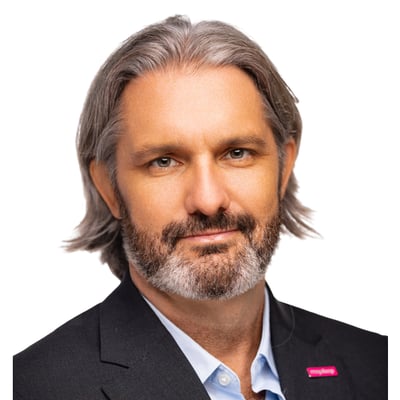
Steve Haley
Global Director, Mojaloop Ecosystem
Mojaloop Foundation
Steve has led diverse impact-driven teams for 22 years in over 10 countries between work in the government, non-profit and the private sector. He aims to influence a more equitable and fair world, particularly through inclusive financial services. At the Mojaloop Foundation, he is driving interoperable real time payments that reach everyone by helping various stakeholders to understand their role in building locally owned, locally controlled, and locally operated payments infrastructure. He holds degrees in Mathematics from West Point and the University of Padova.
Speaking At
-
9:30–10:30amMon 16 NovWorkshopWorkshop Room 1Open
Global Frameworks and Shared Best Practices in Payments Chains
Sovereign Payments: Who Builds, Funds and Controls the Next Generation of Inclusive Instant Payment Systems? - Powered by Mojaloop
-
 H.E. Innocent B. MuhiziRepublic of Rwanda to SingaporeHigh Commissioner
-
 Miatta E. KutehDirector, Payment Systems DepartmentCentral Bank of Liberia
-
 Steve HaleyGlobal Director, Mojaloop EcosystemMojaloop Foundation
-
 Tullo NdundaAdopter Support ManagerMojaloop Foundation
-
 Jean Bosco IyacuChief Executive OfficerMojaloop Foundation
-
 Julie GuettaManaging DirectorThitsaWorks
-
 Walid AhmedDigital Payments Ecosystem AdvisorMojaloop FoundationModerator
About this session
Your payment rails are national infrastructure, so who really controls them? Instant payment systems are now national utilities, yet the key decisions often sit with a single vendor, an outside funder or experts who leave when the contract ends.
Sovereignty has three pillars, and you need all of them. Technical sovereignty means control over the technology and the freedom to change vendors. Skills sovereignty means local people and firms who can run and grow the system. Economic sovereignty means funding that keeps decision-making in national hands.
Sovereignty doesn’t mean going it alone. Open-source tools like Mojaloop, along with shared standards and peer learning, can give countries real ownership while sharing the costs of development and maintenance.
Straight talk from people who have done it. A country leader, a central bank operator, an implementer and a funder discuss where sovereignty is won or lost, from the first procurement decision to long-term operation.
The session will also present draft funding principles that support national ownership instead of eroding it, and invite funders and adopters to help shape them.
-
-
4:15–5:45pmMon 16 NovPublic-Private RoundtableRoundtable Room 4Open
Global Frameworks and Shared Best Practices in Payments Chains
Rethinking Instant Payment Infrastructure from the Ground Up
-
 Blaise Pascal GasabiraChief Executive OfficerRswitch Ltd
-
 Clara B. ArthurChief ExecutiveGhana Interbank Payment & Settlement Systems (GhIPSS)
-
 Irene Arias HofmanChief Executive OfficerMIRA
-
 John MukonoChief Executive OfficerKenswitch
-
Julie GuettaManaging DirectorThitsaWorks
-
 Mark MunneHead of TechnologyNexus Global Payments
-
 Musa Itopa JimohDirector, Payments System Policy DepartmentCentral Bank of Nigeria
-
 Pandu PutraDirector for AsiaCo-Develop
-
Steve HaleyGlobal Director, Mojaloop EcosystemMojaloop Foundation
-
 Matteo RizziSenior Partner, MEAGlobal Finance & Technology Network (GFTN)Moderator
About this session
Most conversations about improving instant payment systems focus on iteration: faster rails, lower costs, broader interoperability. This roundtable asks a more foundational question: are there aspects of how these systems are typically architected that are worth revisiting at the root, rather than only refining at the edges?
Many systems today rely on a model where a payment is sent, and if something doesn’t match up, the two sides exchange after-the-fact messages to reconcile what happened. This reconciliation-heavy approach carries real ongoing cost, and emerging approaches, including early pilot evidence, suggest that dependence on it can be reduced through pre-validation, where payment data is checked and verified before a transaction is executed. Such design choices made early in a scheme’s architecture can shape how easily it extends to full inclusion later.
This session aims to bring together development institutions, instant payments players, central banks, and relevant voices to discuss whether the iterative path – where systems are made incrementally better over time – or the fundamental path – where systems are rebuilt from the ground up – is a more viable solution for national payments systems looking to embark on pre-validation.
The roundtable aims to produce a practical roadmap for countries looking to implement prevalidation across financial institutions. Where available, early pilot data will serve as evidence, discussed frankly under the Chatham House Rule.
-
-
12:30–1:30pmTue 17 NovWorkshopWorkshop Room 1Open
Global Frameworks and Shared Best Practices in Payments ChainsSovereignty & Resilience in a Rewired Financial System
Beyond Borders: Building a Global Defense Against Scams and Financial Fraud - Powered by Tazama
-
 Justus OrtleppHead of ProductTazama
-
 Michelle SempleHead of Growth & OperationsThe Linux Foundation - Project Tazama
-
Steve HaleyGlobal Director, Mojaloop EcosystemMojaloop Foundation
About this session
This workshop explores how shared intelligence, interoperable technology and cross-border collaboration can help combat scams and financial fraud while protecting financial inclusion.
The session will examine real-time fraud monitoring, AI-enabled scam detection and the challenges of protecting transactions across borders, jurisdictions and payment systems. It will also explore how shared taxonomies, neutral governance and responsible intelligence exchange can support coordinated responses.
Through an interactive exercise, participants will identify vulnerabilities in a cross-border scam scenario and propose coordinated interventions, exploring opportunities for industry collaboration.
-

