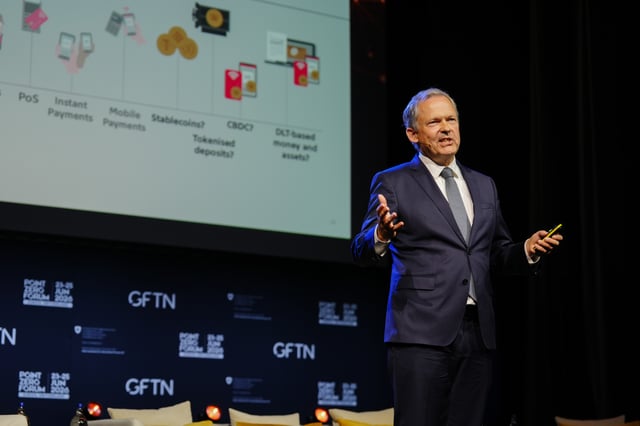
ECB Executive Board Member Piero Cipollone joined GFTN Solutions CEO Maha El Dimachki for a virtual stocktake on the digital euro, fresh off a major legislative milestone — walking through how it's designed to protect bank deposits, what privacy actually looks like in practice, and when Europeans can expect to use it.
The digital euro just cleared a major hurdle — and it was deliberately built not to drain money out of banks.
After a three-year legislative process, the European Parliament's proposal now joins the Commission's and Council's, with all three close enough that the final negotiation (the "trilogue") should move quickly. Cipollone was candid about why the design choices matter: the ECB modeled holding caps between €500 and €3,000, made the digital euro non-interest-bearing, and built a "waterfall" model where wallets don't need to be pre-funded — money moves instantly from your bank account at the moment of payment. The result, per the ECB's own simulations: negligible impact on bank deposits, and no real financial-stability risk.
Privacy for online payments works like it does today; offline payments are designed to be untraceable, like cash
Onboarding still runs through banks and payment providers with standard anti-money-laundering checks, unchanged from today, since 94% of Europeans already have a bank account. For online payments, Cipollone said the ECB itself only ever sees cryptographic tokens, never who actually paid whom. Offline, in-person payments go further: they're a local transfer of data with no record anywhere — from anyone — of payer, payee, or amount, essentially a digital version of handing over cash. The trade-off is that offline payments will likely carry a value cap to manage money-laundering risk, though the exact limit hasn't been set.
On stablecoins, the ECB isn't picking a winner — central bank money is what makes the whole tokenized system possible
Cipollone framed stablecoins and tokenized deposits as different flavors of private money, each better suited to different use cases, with cross-border payments the clearest current fit for stablecoins (though it's not yet clear they're actually cheaper once full costs are priced in). His real point: institutions told the ECB directly they won't put real assets onto tokenized rails without a safe central-bank-money settlement asset underneath — so stablecoins, tokenized deposits, and central bank money aren't competitors, they need each other to grow. On timing: pilot transactions start September 2027, a wider pilot follows in 2028, and full rollout is targeted for 2029 — mostly gated by the scale of onboarding roughly 2,200 banks and millions of merchants. Wholesale tokenized settlement is moving faster: the ECB's Pontes solution launches later this year, linking DLT transactions to its RTGS system, with central bank money itself expected on DLT within two years.
Speaker:
Piero Cipollone, Member of the Executive Board, European Central Bank
Host:
Maha El Dimachki, Chief Executive Officer of GFTN Solutions, Global Finance & Technology Network (GFTN)
Point Zero Forum 2026 | Zurich, Switzerland