


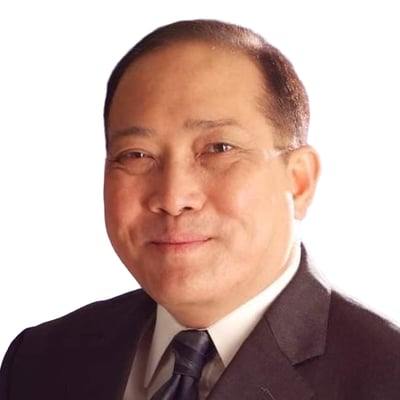
Atty. Rogelio V. Quevedo
Commissioner
Securities and Exchange Commission (Philippines)
One of the pioneers in the Philippines in telecoms and IT law, Prof. Roger Quevedo is an economist and government official with a diverse career, spanning academia, private sector, and public service. He is currently Commissioner of the Securities and Exchange Commission (SEC) of the Philippines. Prior to this, he served as the Government Corporate Counsel, the statutory legal counsel of all Government-Owned and -Controlled Corporations (GOCC) of the Republic of the Philippines.
He graduated from the University of the Philippines (UP) with degrees in Economics and Law, placing 10th in his class and also in the 1981 Bar Exams. He further obtained a Master of Laws from Louisiana State University and a Doctor of the Science of Jurisprudence from Tulane University in New Orleans.
His professional experience includes teaching at the UP College of Law, Ateneo Law School, and Arellano Law Foundation since 1982, specializing in Civil and Commercial Law. He also served as Director of the UP Law Center Bar Review Institute and as the pioneer in Continuing Legal Education. In the private sector, Commissioner Quevedo was the Head of the International Business Division of PLDT-SMART, the leading telecommunications corporation in the Philippines for several decades. His government service also includes roles in the Presidential Management Staff, Office of the Ombudsman, Commission on Immigration and Deportation, COMELEC Advisory Council (CAC), and Commissioner of the Philippine Commission on Good Government. At the local government level, Commissioner Quevedo served as Director of the Youth Development Bureau in the City of Manila.
At Present, Commissioner Quevedo’s role in the SEC is Supervising Commissioner of the Financial and Lending Companies and also for Governance, Enforcement, and Auditing.
Speaking At
-
9:30–11:00amMon 16 NovPublic-Private RoundtableRoundtable Room 1Open
The Scaling Challenge in Tokenized Markets
Tokenized Markets: Frictions, Choices and the Path to Interoperability
-
 Alan CroftsHead of Innovation & FintechFMA New Zealand
-
 Herman SchuellerDirector, Innovation & Technology Risk - SupervisionDubai Financial Services Authority
-
 Jaime PradenasHead of Financial Technology HubCentral Bank of Chile
-
 Katie MitchellHead of APAC & MEA PolicyCoinbase
-
 Kushal BalluckSenior Manager, FMI Innovation & Payments PolicyBank of England
-
 Michael MaurerResearch EngineerMIT Digital Currency Initiative (DCI)
-
 Owureku AsareDirector, FinTech & InnovationBank of Ghana
-
 Peter KerstensAdvisor, DG FISMAEuropean Commission
-
 Atty. Rogelio V. QuevedoCommissionerSecurities and Exchange Commission (Philippines)
-
 Tang WeiHead of Public Policy, Southeast Asia & ChinaStripe
-
 Toh Wee KeeGlobal Head of InsightsKinexys by J.P. Morgan
-
 Ulrich StrohmeierHead of Wholesale CBDCDeutsche Bundesbank
-
 Dr. Wong Huei ChingExecutive Director, Digital Strategy & InnovationSecurities Commission Malaysia
-
 Jael TanHead of Government ProgrammesGlobal Finance & Technology Network (GFTN)Moderator
-
 Maha El DimachkiChief Executive Officer, GFTN SolutionsGlobal Finance & Technology Network (GFTN)Moderator
About this session
Tokenization projects today are often built vertically, with each initiative solving a specific problem within its own ecosystem. Yet tokenizing an asset in isolation does not deliver the full potential of tokenization. Benefits such as atomic settlement and greater capital efficiency depend on interoperability across the entire transaction chain — from the asset and its supporting infrastructure to trading, settlement and the movement of money. The challenge is how countries and institutions can pursue their own tokenization ambitions while avoiding the fragmentation that siloed approaches risk creating.
This roundtable brings together findings from a year of open-call research, alongside problem statements and perspectives from private-sector practitioners navigating the practical choices, risks and constraints of tokenization. It will explore how a decision-making framework can help countries assess their starting points and ambitions, identify the capabilities required across the transaction chain, and consider different pathways towards more interoperable markets. Looking ahead to 2027, participants will discuss emerging problem statements and the coordination, partnerships and policy support needed to connect individual initiatives into a more coherent financial ecosystem.
-

