


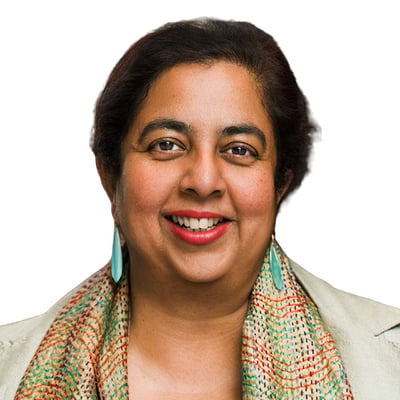
Prof. Shonali Krishnaswamy
Director of Monash AI Institute
Monash University
Prof Shonali Krishnaswamy is the Director of the Monash AI Institute and the Associate Dean Innovation in the Faculty of Information Technology at Monash University. Prior to this Shonali, was the CTO and Co-Founder of AiDA Technologies (www.aidatech.io), a multi-award winning Machine Learning (ML) start-up from Singapore, delivering AI-based Claims Processing technologies for Health Insurers in Singapore and the ASEAN region. AiDA was acquired by AIA.
AiDA's marquee product SMART-CLAIMS is an AI-based solution for automating the processing of Health Insurance Claims and detecting/preventing Fraud, Waste, and Abuse. SMART-CLAIMS has been adopted by several major insurers in Singapore and increasingly in the ASEAN region.
Before starting her entrepreneurial journey, Shonali was Head of the Data Analytics Department at the Institute for Infocomm Research (I2R), which is part of the Singapore Government's national R&D arm, the Agency for Science, Technology and Research (A*STAR). As Head of Data Analytics at I2R, Shonali led a research team of 70 Data Science researchers and engineers and focused on R&D innovation labs and collaboration projects across multiple industry sectors including Financial Services, Telecommunications, Healthcare and Aerospace. She has also previously held academic/professorial appointments in Australia at Monash University and Swinburne University.
Shonali is the recipient of several national and international awards including an ARC Australian Postdoctoral Fellowship, Monash University Vice-Chancellor's Award for Excellence in Research by an Early Career Researcher, the Institute of Engineers Singapore Prestigious Engineering Award, the ASEAN Outstanding Engineering Award, and an IBM Innovation Award. In 2020, Shonali was recognised as one of Singapore's Inaugural 100 Women in Technology by the Infocomm Media Development Authority (IMDA) and the Singapore Computer Society (SCS). More recently, in March 2024, Shonali was recognised as one of Asia's Top 50 Women Technology Leaders.
LinkedIn: https://sg.linkedin.com/in/shonali-krishnaswamy-b532204
Speaking At
-
3:45–5:15pmTue 17 NovPublic-Private RoundtableRoundtable Room 4Open
Shaping Tomorrow's Innovation
Is AI Pulling the Ladder Up? Reimagining Job-Ready Skills in the AI Transition
-
 Dr. Roy AmlanPartner LCP, Research Associate LSE (FMG & SRC), Author “Demographics Unravelled”LCP & LSE
-
 Anuprita BhomickHead of Customer ExperienceGoogle
-
 Arvind SankaranSenior Fintech ExpertAsian Development Bank
-
 Carolyn NeoChief Executive OfficerInstitute of Banking & Finance
-
 Drew PropsonHead of Technology & Innovation in Financial ServicesWorld Economic Forum
-
 Osamu AbeChief of Staff, Asia PacificMUFG Bank Ltd
-
 Priyank HiraniVice President of Programsdata.org
-
 Prof. Shonali KrishnaswamyDirector of Monash AI InstituteMonash University
-
 Tram Anh NguyenChairwoman, Global Women in AI & Co-FounderCFTE (Centre for Finance, Technology and Entrepreneurship)
-
 Akanksha RathHead of Capacity BuildingGlobal Finance & Technology Network (GFTN)Moderator
About this session
The white-collar skills that have historically lifted millions out of poverty across emerging economies are now facing disruption from AI. In the Philippines alone, the ILO estimates that more than a quarter of the workforce — some 12.7 million workers — holds jobs at risk of being displaced by AI automation. Most of these roles will be transformed rather than eliminated outright, but the shift is already reshaping what "job-ready" means for graduates and mid-career workers alike.
This roundtable brings together policymakers, regulators, educators, and industry leaders to confront the anxiety facing today's fresh graduates and mid-careerists, many of whom were trained for a job market that is changing faster than their curricula can keep pace with. Panelists will chart the policy interventions, employer strategies, and new models of education that will define career pathways for the next generation of workers in emerging economies. -

