.svg "Group 2238 (2)")
.svg)
.svg)
%20(1).svg)
%20(1).svg)
.svg)
Share Article



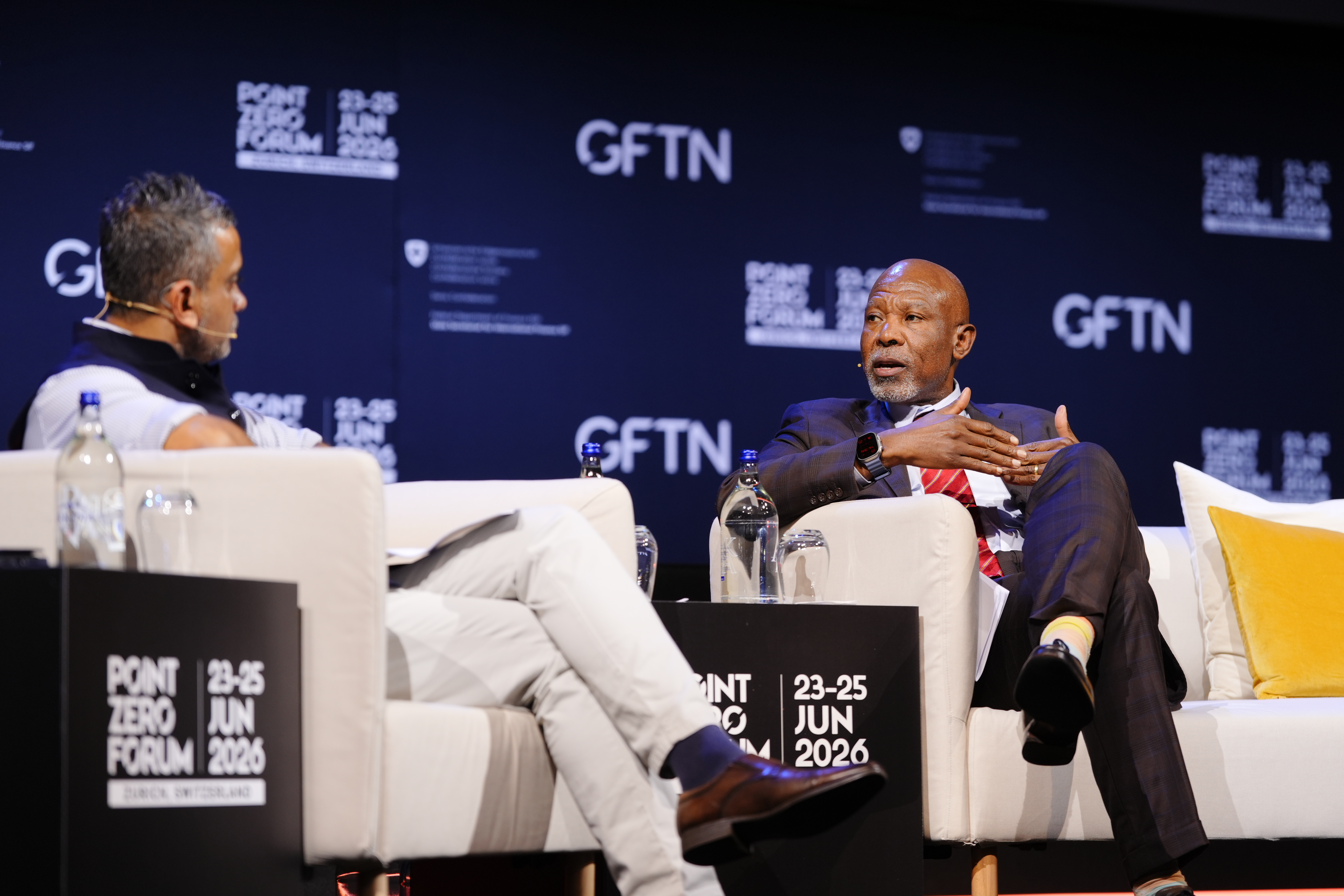

Lesetja Kganyago, Governor of the South African Reserve Bank, joined GFTN's Pat Patel for a wide-ranging fireside chat — covering why trust in central banks is so easily lost, why private money already outweighs what central banks issue, and why he thinks the real risk in finance right now isn't moving too fast, but moving too slow.
Central bank trust takes years to build and seconds to lose: right now, it's under attack from every direction
Kganyago said both inflation and eroding institutional trust worried him, because failing on price stability is exactly what destroys public trust in the first place. What makes this moment different from the 2022–23 inflation surge is that the memories are still fresh, and attacks on institutions are no longer coming from just one political direction — left-wing populists, right-wing populists, and even supposedly centrist leaders are all doing it.
Kganyago's not worried that private money dwarfs what central banks issue. His only condition: it has to be interchangeable
In South Africa, the central bank's own money in circulation is about 500 billion rand; money created privately through bank lending is roughly 6 trillion rand — twelve times as much. What matters isn't who created it, he said, but that "a dollar is a dollar" regardless of source — what central bankers call the singleness of money. That was why he was open to stablecoins too, so long as they're genuinely stable, properly backed, and paired with clear rules for interoperability and on/off-ramps into central bank money. His lightning-round verdict: stablecoins are a complement, not a competitor, and retail CBDCs are optional — it's still unclear what problem they'd actually solve, while wholesale CBDCs already work and are ready to use.
Why central banks should fear moving too slowly far more than moving too fast — and what Africa proves
Kganyago pointed out that society punished visible policy failures far more than it punished the quiet failure to embrace something that could have helped — a bias that made regulators overly cautious by default. He illustrated how fast adoption can move today: landline telephony took roughly 900 months to reach 100 million people, mobile took 180, TikTok took 9, ChatGPT took 2. Because Africa couldn't build bank branches everywhere, it leapfrogged straight to mobile wallets — the continent now accounts for the majority of the world's digital wallets and roughly 70% of this kind of transaction volume. Looking ahead, his biggest worry isn't slow adoption, it's blind spots in AI — and making sure the technology brings people into the financial system rather than leaving them further behind.
Speaker:
Lesetja Kganyago, Governor, South African Reserve Bank
Host:
Pat Patel, Chief Executive Officer, USA, LATAM, MEA & Co-CEO, Forums, Global Finance & Technology Network (GFTN)
Point Zero Forum 2026 | Zurich, Switzerland