.svg "Group 2238 (2)")
.svg)
.svg)
%20(1).svg)
%20(1).svg)
.svg)
Share Article





Pakistan banned digital assets outright in 2018. Eight years later, it quietly became the third-biggest digital asset market in the world, with no formal regulation and no state support. This year, it reversed course entirely — a new Virtual Assets Act, a dedicated regulator, a licensing window opened in under six months.
This reversal reframed the real question at the Silk Road Finance & Technology Forum. It's not whether AI and tokenization is outpacing regulation, but what a regulator does once it accepts that they will.
Three regulators, three different bets on when to step in
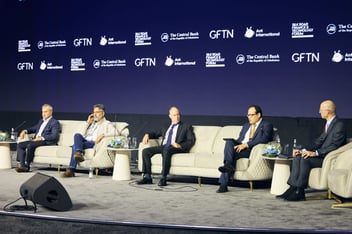
Moderator Dr. Odiljon Abdurazzakov asked all three the same thing: does regulating too early worry you more, or too late? Governor Chea Serey of the National Bank of Cambodia and Deputy Governor Vusal Khalilov of the Central Bank of Azerbaijan both leaned toward patience — early rules can scare off investment before a market's real risks are visible. Bilal Bin Saqib, Chairman of Pakistan's Virtual Assets Regulatory Authority, disagreed: technology moves exponentially, policy moves linearly, and a state that declines to regulate isn't staying neutral, it's freezing itself out.
Each backed the philosophy with a build. Chea Serey's central bank let the market move first with Bakong, its blockchain payment rail — built in 2017 to stop a few dominant players from crowding out smaller ones and to chip away at 90% dollarization, not to chase a trend. It now links seven countries' payment rails, reaches 4.5 million merchants, and carries transaction volume ten times Cambodia's GDP. Khalilov's central bank moved early and internally instead, sorting every AI use case into one of three buckets — sensitive data stays on internal models, everything else can run on proprietary ones, anonymization bridges the middle — and using a regulated sandbox to test both AI and crypto products before rules are final. Bin Saqib's authority is running the widest bet: tokenization pilots across real estate and Pakistan's stock market, $2 billion of sovereign debt, and the $13 billion Roshan Digital Account program moving onto blockchain rails. The sharpest number: Pakistan takes in $41 billion a year in remittances at a World Bank-estimated 5–6% cost. On stablecoins, he said, that drops below 1% — over $1.5 billion a year staying in the households that need it.
By 2030, the harder problem is machine versus machine
All three converged on cost, speed, and inclusion as the clear upside by 2030. The harder problem, they agreed, is what happens once AI agents — not humans — are the ones transacting around the clock.
"It has to move from human versus machine to machine versus machine."
- Bilal Bin Saqib
Abdurazzakov closed on the panel's throughline: the real choice was never regulation versus innovation. It's finding regulation that builds enough trust for innovation to keep going.
Speakers:
Bilal Bin Saqib, Chairman, Pakistan Virtual Assets Regulatory Authority
H.E. Chea Serey, Governor, National Bank of Cambodia
H.E. Vusal Khalilov, Deputy Governor, Central Bank of Azerbaijan
Host:
Dr. Odiljon Abdurazzakov, Dean, School of Management, New Uzbekistan University
Silk Road Finance & Technology Forum | Tashkent, Uzbekistan