.svg "Group 2238 (2)")
.svg)
.svg)
%20(1).svg)
%20(1).svg)
.svg)
Share Article



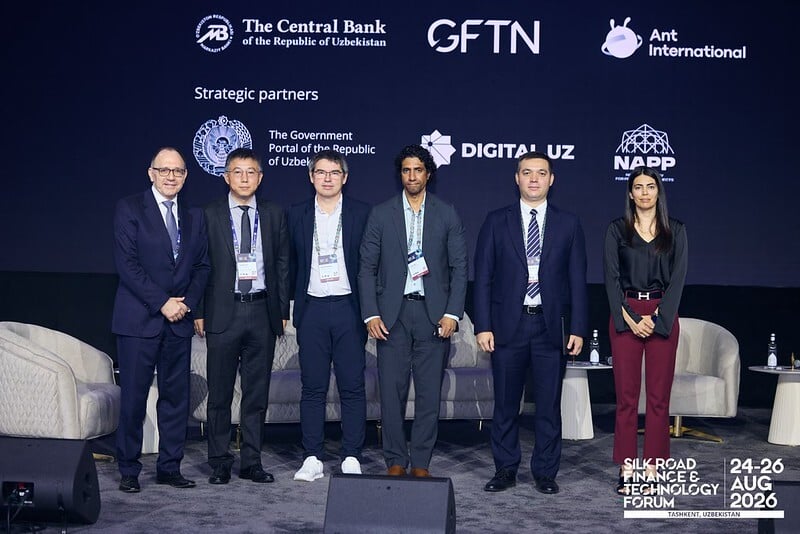

Of the roughly $60 trillion that moved across public blockchains last year, China's central bank found that less than 1% had a genuine payment background. The rest was internal rebalancing, protocol splitting, and arbitrage. Dropped midway through this panel, that statistic reframed the real question: not whether stablecoins and tokenization work, but what it actually solves.
Stablecoins, tokenized assets, or CBDCs? They fit different needs
Moderator Dr. Peter Gassmann opened by separating three terms people use interchangeably: a stablecoin (privately issued, reserve-backed), a tokenized asset (a wrapper around something real — a bond, a fund, property), and a CBDC (sovereign digital money). Mu Changchun argued the "right" choice depends entirely on a jurisdiction's needs and constraints. Economies with capital controls tend to lean toward CBDCs, while deep capital markets like the US can be more open to stablecoins.
Uzbekistan needs to avoid duplicating what already works
Samigjon Inogamov pointed out that Uzbekistan already receives instant, low-friction remittances - $9.3 billion in the first half of the year, most landing directly on bank cards, inside the existing regulatory perimeter. That's the exact problem stablecoins are usually pitched to solve elsewhere.
His conclusion: the country's task isn't adoption, it's figuring out where tokenization adds genuine value. Rajesh Sabari sees an institutional opportunity in collateral mobility - tokenizing government debt so treasurers can deploy it faster. Telegram's Pavel Khristolyubov called retail adoption still a "green field," years behind the wholesale/regulatory conversation happening on stage.
The bottleneck isn't the technology. It's trust
Dr. Saeeda Jaffar argued that regulation is what lets people trust a payment method without thinking about it - something cash and cards already have. Hon. Vyacheslav Yurevich Pak added that tokenized securities remain unsolved everywhere: no country has yet worked out how a token holder exercises voting rights or corporate governance the way a shareholder does today.
Changchun closed the panel with its sharpest line: what's missing isn't custody or wallets, it's cross-border regulatory coordination and real enforcement. "Establish the rules before you pave the channels. You have to dig the pond before you reach the fish."
Speaker:
Mu Changchun, Director - General, Digital Currency Institute, People's Bank of China
Pavel Khristolyubov, Chief Operating Officer, Wallet in Telegram
Rajesh Sabari, Chief Commercial Officer, Liminal Custody
Samigjon Inogamov, Director, Monetary Policy Department, Central Bank of Republic of Uzbekistan
Dr. Saeeda Jaffar, Managing Director, International, Circle
Hon. Vyacheslav Yurevich Pak, First Deputy Director, National Agency of Perspective Projects
Host:
Dr. Peter Gassmann, Senior Partner, PwC Strategy
Silk Road Finance & Technology Forum | Tashkent, Uzbekistan

.jpg?width=352&name=What%20Makes%20Money%2c%20Money%20Ensuring%20Trust%20in%20the%20Next-Generation%20Financial%20System%20-%20Keynote%20by%20Andr%C3%A9a%20Maechler%2c%20Deputy%20General%20Manager%2c%20Bank%20for%20International%20Settlements%20(BIS).jpg)