


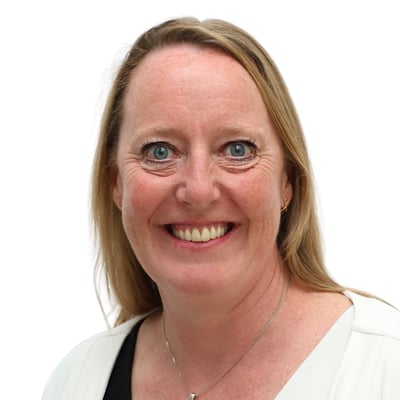
Karen O'Sullivan
Head of Innovation, Payments, Market Infrastructures & Governance Department
Commission de Surveillance du Secteur Financier (CSSF)
Karen coordinates the activities of her department which is responsible for financial innovation, both the application process and on-going prudential supervision of payment institutions and electronic money institutions, the registration and AML supervision of virtual asset service providers, market infrastructures and the oversight of remuneration and governance practices and policies implemented within financial institutions.
Furthermore, her team is responsible for coordinating the CSSF’s efforts with regards to MiCA Regulation. In this respect her team spearheads the CSSF’s internal MiCA taskforce and is responsible for the authorisation and going forward the subsequent supervision of crypto-asset service providers and certain EMT/ART issuers.
Being the department in charge of financial innovation means that Karen and her team are the privileged contact and point of entry to the CSSF for the FinTech industry.
Speaking At
-
1:30–3:00pmTue 17 NovPublic-Private RoundtableRoundtable Room 2Open
The Scaling Challenge in Tokenized MarketsGlobal Frameworks and Shared Best Practices in Payments Chains
Programmable Compliance: Which Rules Travel with the Money, and How?
-
 Audrey MetzgerDirector of Innovation & Financial Market InfrastructuresBanque de France
-
 Prof. Bob WardropFounder & Chief Executive Officer of RegGenomeCambridge University & RegGenome
-
 Ceridwen ChooChief Executive OfficerCleanverse International Pte Ltd
-
 Jonathan MiddletonTechnology Policy & AdvisoryFinancial Innovation for Impact
-
 Karen O'SullivanHead of Innovation, Payments, Market Infrastructures & Governance DepartmentCommission de Surveillance du Secteur Financier (CSSF)
-
 Lindsey ArgalasChief Executive OfficerTaxbit
-
 Matthias ObrechtHead Supervision New TechnologiesSwiss Financial Market Supervisory Authority (FINMA)
-
 Sonja DavidovicSenior Digital Expert on Transformative TechnologyInternational Monetary Fund
-
 Varlam EbanoidzeHead of FinTech Development & Innovation OfficeNational Bank of Georgia
-
 Vinay PalathinkalGeneral Manager, APACLorum
-
 Nilixa DevlukiaChairOpen Finance AssociationModerator
About this session
As money becomes programmable, across central bank digital currencies, tokenized deposits, and stablecoins, a real question is emerging about where compliance should live: embedded directly in the asset as a rule that travels with it, layered on top through richer messaging and real-time screening, or enforced separately by whichever party touches the transaction last.
Players are all building credible but different answers in parallel, and none has converged on how these should interoperate across jurisdictions with different compliance regimes. The stakes are rising on every front — real-time cross-border settlement, tokenized securities, and increasingly, autonomous agents initiating transactions on their own — all of which need a compliance check at the moment value moves, not after. What would each of these approaches to programmable compliance actually need to interoperate, and which rules win when they conflict across borders?
Discussion questions:
1\. Should compliance logic live in the asset itself, in the messaging/settlement layer, or in a separate real-time screening service, and does the answer change depending on whether it's a CBDC, a tokenized deposit, or a stablecoin?
2\. When a transaction crosses borders, whose compliance rule actually governs — sender's jurisdiction, receiver's, or the rail's — and what happens when they conflict?
3\. Retrofitting compliance onto existing settlement infrastructure and building it in from scratch are both live strategies right now — what would each need to prove to become the default, and is convergence between them actually possible?
4\. As more transactions — including those initiated by autonomous agents — require a compliance check the moment value moves, what are the minimum interoperability standards needed for rules to actually travel with money across rails?
-

