.svg "Group 2238 (2)")
.svg)
.svg)
%20(1).svg)
%20(1).svg)
.svg)
Share Article





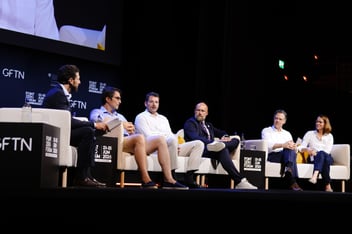
A day before this panel, the odds of the US CLARITY Act passing were cut from 50% to 20%, collateral damage from Donald Trump abruptly pushing a different bill onto the Senate floor instead. Five policy leaders picked through the wreckage, debating whether the EU's MiCA or the emerging US framework actually deserves to be the global model for digital asset regulation.
MiCA's first licensing round separated paper-ready firms from practice-ready ones
Vaida Česnulevičiūtė – Markevičienė said Lithuania's regulator had to staff up fast and ultimately extended its transition period because the market asked for more time, and ended up licensing four strong companies. Not every applicant was equally prepared, she said: some firms underestimated that MiCA requires a full license, not just registration, while others invested properly in governance, controls, and market-abuse monitoring. She also flagged a market shift MiCA didn't fully anticipate: e-money tokens are live and functioning, but asset-referenced tokens are essentially absent across Europe, and commercial energy is flowing toward payments rather than trading, with traditional banks still experimenting rather than fully embracing crypto.
The CLARITY Act's odds just dropped from 50% to 20%
Justin Slaughter said the GENIUS Act is already stable law and increasingly accepted even by crypto's harshest critics, but the broader CLARITY Act ran into real trouble the day before the panel, after Donald Trump signaled he wanted a different bill on the Senate floor in July instead, pushing any real floor action to September at the earliest and colliding with the legislative freeze that comes with midterm election season. That news alone, he said, dropped his personal odds of CLARITY passing from roughly 50% to about 20%, and he argued the industry underestimated both how quickly its legislative window would shrink and how many Democratic staffers still don't fully grasp crypto's value.
GENIUS Act's "comparable" standard beats MiCA's "equivalent" one
Stu Alderoty said Ripple's own stablecoin, RLUSD, hit roughly a $1.6 billion market cap in under two years, yet MiCA's lack of clarity around "single issuance" has kept Ripple from actually issuing it within the EU, even as some incumbents appear to get grandfathered treatment, something he called anti-competitive and confusing for customers. He contrasted that with the GENIUS Act's reciprocity design, which Lesley Chavkin explained was deliberately built around a "comparable," not "equivalent," standard for foreign frameworks, letting a foreign issuer that meets US minimum standards trade its stablecoin domestically. Alderoty's dividing line: rules that protect consumers, like disclosure, reserve, and AML requirements, are legitimate, but rules designed to protect local incumbents from competition are protectionism, and he pointed to dollar-denominated stablecoins making up 99% of the global stablecoin market as evidence that regulation should reflect that reality rather than fight it.
Speakers:
Brian Quintenz, Advisor and Board Member, Ubyx, SUIG, KalshiEx
Justin Slaughter, VP, Regulatory Affairs, Paradigm
Lesley Chavkin, Head of Policy, Rabbit Capital
Stu Alderoty, Chief Legal Officer, Ripple
Vaida Česnulevičiūtė – Markevičienė, Deputy Chair of the Board, Bank of Lithuania
Host:
Candace Kelly, Chief Legal & Policy Officer of Stellar Development Foundation
Point Zero Forum 2026 | Zurich, Switzerland