.svg "GFTN")
.svg)
.svg)
%20(1).svg)
%20(1).svg)
.svg)
Share Article



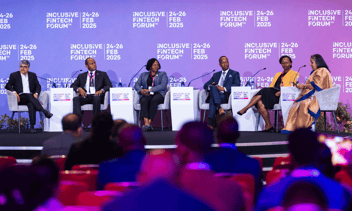
At the 2026 Inclusive FinTech Forum in Kigali, central bank governors from across Africa met behind closed doors to confront a shared challenge: how to govern a financial system being rewritten by technology without compromising stability or inclusion.
Digital transformation is here; standing still is not an option
Digital transformation is no longer a distant prospect for African financial systems; it is already reshaping how people save, pay, borrow, invest and move value across borders. At a Governors’ Roundtable on 10 March 2026 during the Inclusive FinTech Forum in Kigali, central bank leaders from East, Southern and West Africa agreed that the public sector must respond with deliberate, coordinated regulatory strategies, because standing still is no longer a neutral position.
The roundtable, moderated by Maha El Dimachki, CEO Advisory at the Global Finance & Technology Network (GFTN), focused on how regulatory and supervisory frameworks must evolve in an era defined by virtual currencies, tokenized assets and increasingly seamless cross‑border payments. Governors highlighted that Africa’s digital finance success story, from mobile money to instant payments, is only the visible layer; the deeper question is whether institutional capacity, data governance, cyber resilience, digital public infrastructure and crisis‑management frameworks are keeping pace.
Participants also reflected on the inherent tension between the ambition of policymakers and the caution of regulators. Political leaders may have a higher appetite for risk while central banks must build robust foundations for innovation. As one governor put it, central bankers are often tasked with “removing the punch bowl while the party is still in full swing”; never popular, but essential to preserving trust and stability.
From prohibition to learning-led regulation
A central theme of the discussion was how to regulate innovation without stifling it. Central Bank Governors agreed that experimentation is now a regulatory necessity: jurisdictions that have progressed from desk‑based research to sandboxes and controlled pilots are generating real‑world insights that theory alone cannot provide.
The journey of several central bank digital currency (CBDC) projects illustrated this point. One central bank described a structured progression from initial research to proof of concept and into a pilot phase that will test offline functionality, merchant use cases, cross-border payments and scalability across a broader population – all with the aim of informing a cautious, evidence‑based decision on full issuance. Another jurisdiction has built a complete legal framework for virtual asset service providers, only to find that commercial banks remained reluctant to onboard them; a reminder that regulatory readiness and market readiness are not the same thing.
Nowhere has the shift in mindset been more visible than in the approach to virtual assets. Two years ago, it would have been difficult to convene an open, technical discussion on crypto at a gathering of African central banks. Today, with billions of dollars in virtual assets flowing into the continent annually and only a handful of countries having put frameworks in place, the case for pragmatic engagement is unavoidable.
Most participants favoured a cautious, learning‑led approach: accepting the reality of virtual assets, creating monitoring and licensing regimes, and preserving core principles of monetary sovereignty, financial stability and consumer protection. In one country, a draft virtual assets law reflects this philosophy by permitting participation by qualified investors and licensing service providers, while maintaining clear guardrails around payment instruments and legal tender status. Throughout the discussion, governors stressed that effective regulation cannot be designed in the abstract; it requires close engagement with innovators, structured testing environments and the willingness to adjust rules as risks and use cases become clearer.
Infrastructure, AI and Africa’s opportunity to shape the future
The Governors’ Roundtable also surfaced a critical, often overlooked dimension of digital readiness: the “infrastructure beneath the infrastructure.” One governor described how prolonged power outages caused by drought, in some cases lasting up to seventeen hours, exposed the dependence of digital finance on resilient energy systems, robust telecommunications networks and cross‑sector contingency planning that extends beyond the central bank’s direct mandate. Cross‑border interoperability remains another pressure point, with regional payment systems still working to realize their full potential and regulatory harmonization across jurisdictions proving complex.
Looking ahead, participants identified three frontier technologies that will fundamentally reshape financial services: artificial intelligence, tokenization and, over a longer horizon, quantum computing. AI has the potential to improve fraud detection, enhance operational efficiency and ease long‑standing interoperability frictions, but it also amplifies cyber and conduct risks. Tokenization is already beginning to change how assets are structured, monitored and exchanged, while quantum computing raises profound questions about the encryption standards on which the entire digital financial system rests.
For African central banks, the implication is clear: capacity building must move in lockstep with policy development. Governors emphasized the need to invest in specialized talent, supervisory technology and institutional knowledge, and to treat institutional readiness with the same urgency as innovation itself. Many saw a distinct opportunity: Africa is not merely digitizing legacy systems; in many markets, new rails are being built from the ground up, creating a chance to design a more inclusive, interoperable and efficient digital financial architecture from the outset.
A shared agenda for the next digital economy
By the end of the session, there was a clear sense that this dialogue is only beginning. The coming decade will test whether African regulators can keep pace with technological change while safeguarding stability and inclusion. Participants pointed to several areas where deeper collaboration is now essential: AI governance and supervisory use‑cases, tokenization standards, quantum‑resilient infrastructure, and cross‑border regulatory convergence.
The message from Kigali was both realistic and hopeful. Technology is rewriting the architecture of finance. If African central banks continue to experiment responsibly, share lessons openly and invest in institutional capability, the continent may not simply adopt the financial system of the digital age; it could help shape it from the outset in the public interest.