


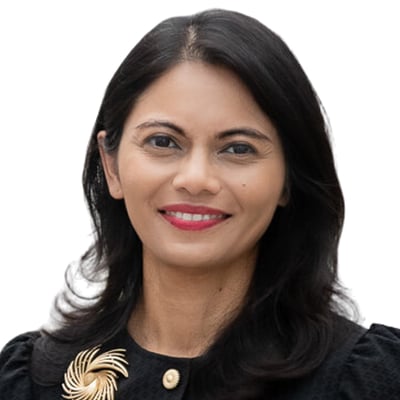
Usha Chandradas
Consultant
Withers KhattarWong LLP
Usha brings a distinctive blend of legal, tax and arts expertise, drawing on 20 years of experience across private practice, government, academia, and the creative sector.
Usha advises clients on tax-efficient wealth structuring, tax disputes and philanthropic giving, with a particular interest in cultural philanthropy and the stewardship of art collections. She has a strong track record advising high-net-worth individuals, families, family offices and local and multinational corporates, particularly on complex, cross-border matters. Her dual focus on tax and the arts enables her to provide distinctive counsel at the intersection of wealth, policy and culture.
A former partner of the tax practice group in a leading law firm, Usha began her legal career at the Inland Revenue Authority of Singapore, where she served in the Law Division with postings in Enforcement, Policy & Rulings and International Tax. She later joined the International Monetary Fund’s Legal Department Panel of Experts, providing technical assistance to governments on tax legislation and administration. Usha is an Advocate and Solicitor of the Supreme Court of Singapore, a Chartered Accountant (non-practising), and an Accredited Tax Specialist (Income Tax) with the Singapore Chartered Tax Professionals. She also holds Master’s degrees in Professional Accounting (Singapore Management University) and Asian Art Histories (Goldsmiths, University of London).
In the arts space, Usha is best known as co-founder of Plural Art Mag, a widely respected online platform dedicated to making Southeast Asian contemporary art more accessible. She has written and spoken extensively on regional art and cultural policy; and has served as a Nominated Member of Parliament representing the arts sector.
In addition to her practice, Usha is an Adjunct Associate Professor at the Nanyang Business School (Nanyang Technological University), where she lectures on international tax and trade law. She also serves on the board of the Intellectual Property Office of Singapore and actively contributes to the community through volunteer work with Pro Bono SG, the Singapore Red Cross, and the Singapore Medical Association Charity Fund. She is also an independent director on the boards of two publicly listed entities—one in the real estate investment trust (REIT) sector and the other in healthcare—where she brings legal and commercial insight to board deliberations.
Usha’s multidisciplinary background enables her to approach each client’s needs with creativity, sensitivity and rigour – especially those navigating legacies that span generations, geographies and cultures.
Speaking At
-
3:30–4:15pmTue 17 NovSummit StageSummit Stage, Sands Expo & Convention Centre, Level 5Invite-Only
Others
How Should Ultra-High-Net-Worth Families Hold and Structure Their Wealth?
-
 Amb. Jean de Dieu UwihanganyePrincipal, Emerging Markets & Business Development, Raffles Family Office. Former Minister of state for Infrastructure & High Commissioner of Rwanda to Singapore, Australia, New Zealand
-
 Shilpi ChowdharyGroup Chief Executive OfficerLighthouse Canton and Keenai Global
-
 Usha ChandradasConsultantWithers KhattarWong LLP
-
 Won-Suck SongVenture PartnerStonehammer Sarl
-
 Alex PanicanActing Chief Executive OfficerLuxembourg House of Financial TechnologyModerator
About this session
As substantial wealth passes from one generation to another, the priorities of families and their expectations of the institutions serving them are changing.
While first-generation wealth creators have often prioritised control and preservation, their successors may place greater value on time, convenience, technology and different forms of financial advice.
How will the next generation approach investment decisions, risk and governance?
How can families prepare successors to assume responsibility for wealth, and what must private banks, family offices and advisers do to remain relevant as relationships and decision-making authority change hands?
-

